
What Are Python Data Types?
By Waqas Hussain (GlitchWH) Computer System Engineering student specializing in Python and Cyber Security
Introduction
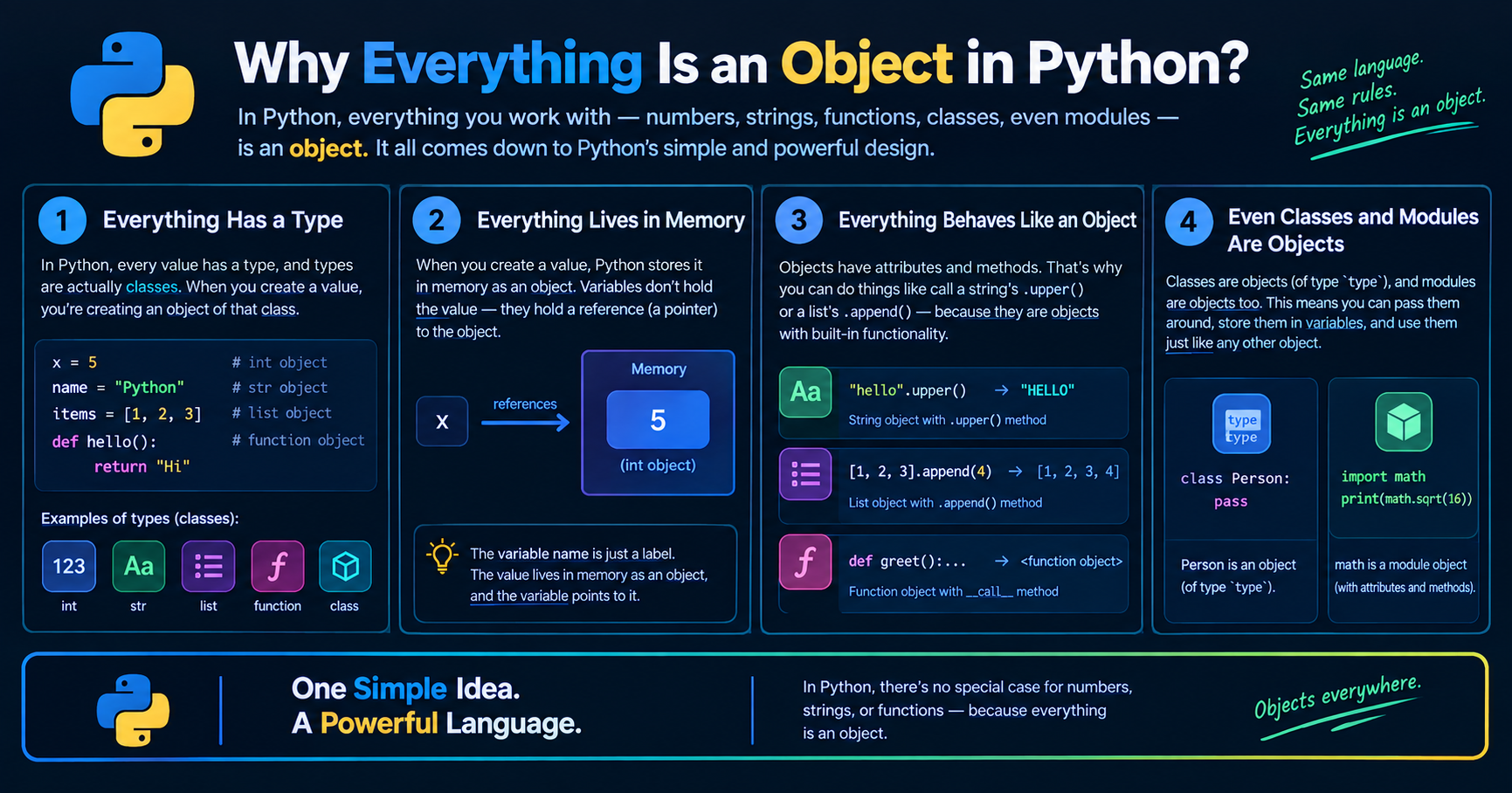
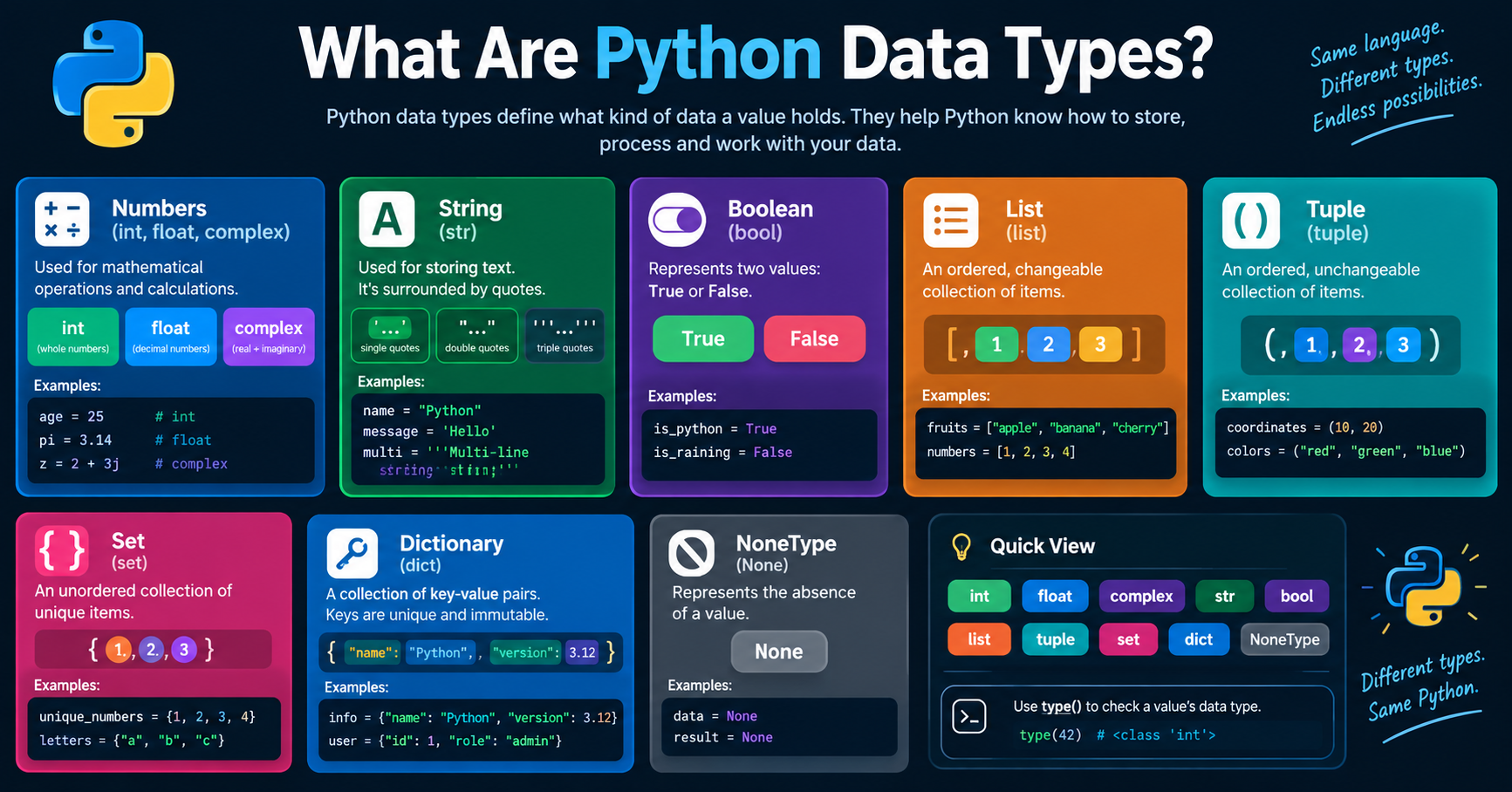
Every value in Python a number, a word, a list of items belongs to a specific data type. The type tells Python what kind of data it's dealing with, and more importantly, what it can do with that data. You can't add a number to a word, but you can add two numbers. Data types are the rules behind that logic. Let's break down exactly what they are and how Python handles them.
A Data Type Defines Behavior, Not Just Appearance
A data type isn't just a label it defines what operations are valid on that value. An int supports addition and subtraction. A str supports concatenation and slicing. Trying to do 5 + "5" fails, not because Python is being difficult, but because the int and str types don't define compatible behavior for + between them. Type determines capability.
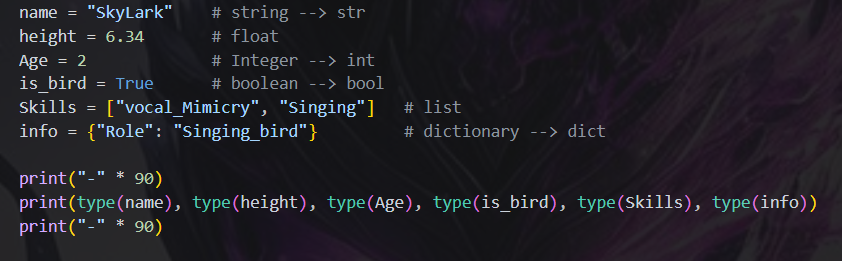
example give:


Numeric Types: int, float, complex
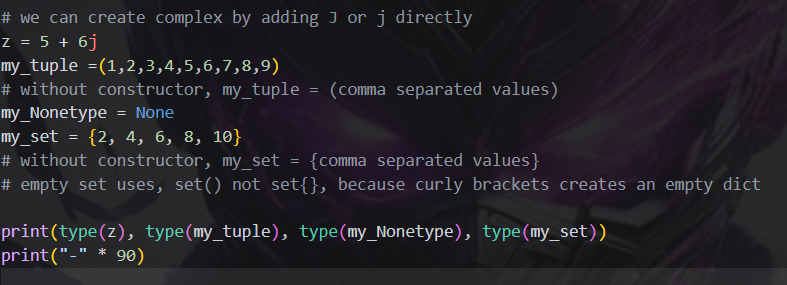
Python has three built-in numeric types. int handles whole numbers (21, -10), with no fixed size limit, Python automatically expands memory as numbers grow larger. float handles decimal numbers (5.9, 3.14), stored using floating-point representation, which is why you sometimes see tiny rounding errors like 0.1 + 0.2 == 0.30000000000000004. complex handles numbers with a real and imaginary part (3 + 4j), mainly used in scientific and engineering computations.
Text Type:str
A str (string) represents text, always wrapped in quotes ,"SkyLark" or 'Python'. Strings in Python are immutable, meaning once created, their characters can never be changed in place. If you "modify" a string, Python actually creates a brand-new string object behind the scenes. Strings support powerful operations like slicing (name[0:3]), concatenation (name + "Cute"), and formatting.
Boolean Type: bool
bool represents one of exactly two values: True or False. Booleans are actually a special subclass of int in Python True behaves like 1, and False behaves like 0. This is why True + True evaluates to 2. Booleans are the backbone of all conditional logic every if statement ultimately evaluates down to a bool, we will study that later.
Sequence Types: list and tuple
A list (["vocal_Mimicry", "Singing"]) is an ordered, mutable collection you can add, remove, or change items after creation. A tuple ((1,2...)) looks similar but is immutable, once created, it cannot be changed. Real-world rule of thumb: use a list when data will change over time (like a to-do list), and a tuple when data should stay fixed (like coordinates or a date).
Mapping Type: dict
A dict ({"role": "Singing_Bird"}) stores data as key-value pairs, similar to a real dictionary where a word (key) maps to its meaning (value). Dictionaries are extremely fast at looking up values by key, because internally they use a data structure called a hash table. This makes dictionaries ideal for structured data like storing a user's profile, or mapping IP addresses to request counts in a security log.
Set Type: set
A set {2,4,6....} is an unordered collection of unique values, duplicates are automatically removed. Sets are commonly used when you care about membership ("is this value present?") rather than order, and they're extremely efficient for that purpose. A practical example: storing unique visitor IPs from a log file, where duplicates don't matter.
The Empty Type: NoneType
Python has a special type called NoneType, with exactly one value: None. It represents the absence of a value , not zero, not an empty string, but literally "nothing here." It's commonly used as a placeholder before a real value is assigned, or as a return value from a function that doesn't explicitly return anything.
Python Is Dynamically Typed
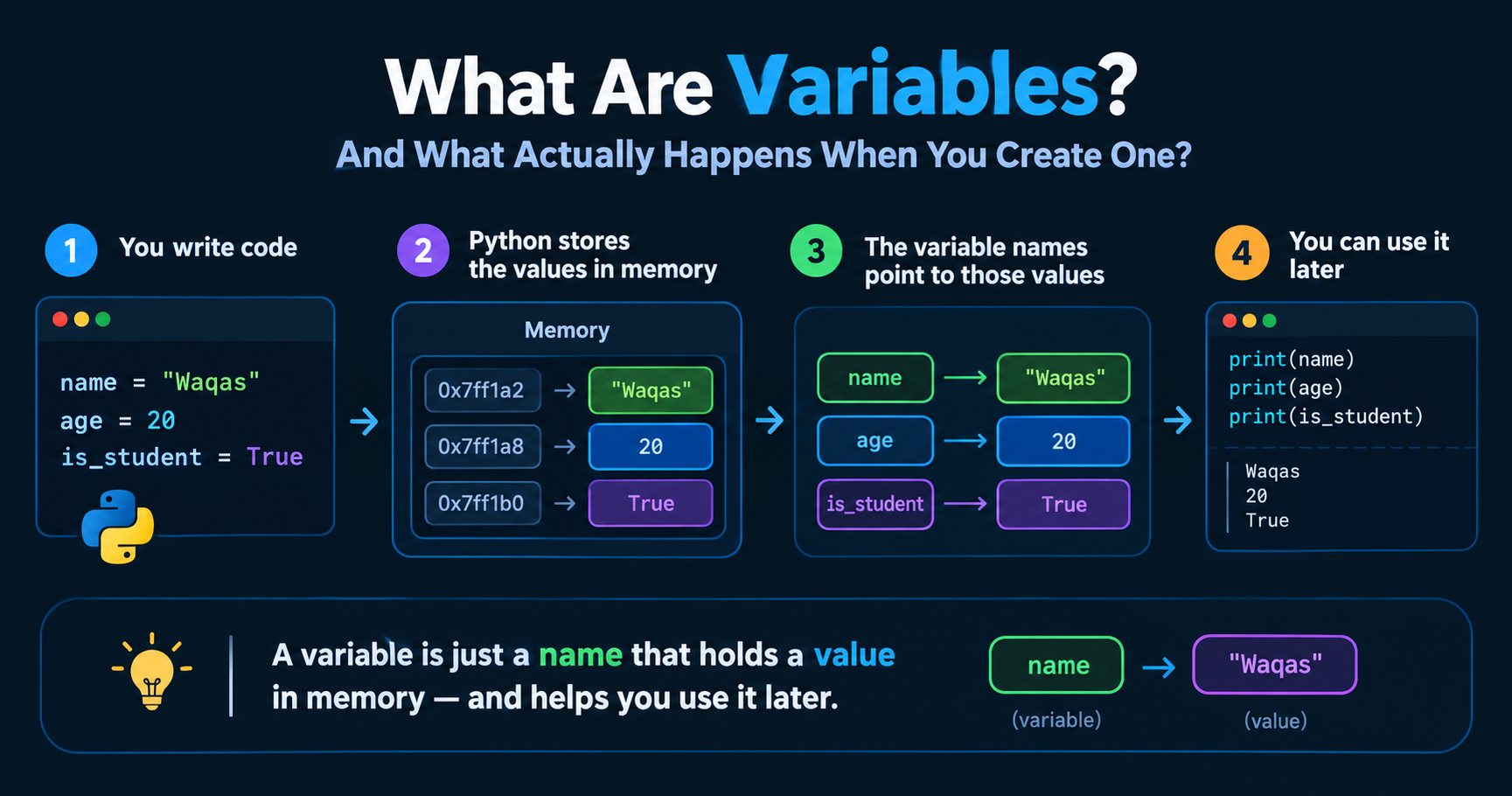
You never declared age as an int, Python figured it out automatically based on the value you assigned. This is called dynamic typing. Behind the scenes, every value still has a strict, fixed type, Python just doesn't require you to announce it upfront like C++ or Java does. You can always check a variable's current type using the built-in type() function.
Why This Matters
Understanding data types isn't just theory, it directly explains real errors you'll hit early on, like TypeError: can only concatenate str (not "int") to str. It also shapes how you design programs: choosing a list vs a tuple, or a dict vs a set, is a decision based entirely on the behavior each type offers.
Conclusion
Every value in Python carries a type, and that type defines what you can do with it. Numbers calculate, strings represent text, lists and tuples hold ordered collections, dictionaries map relationships, sets track uniqueness, and None represents nothing at all. Python figures out these types automatically but understanding them yourself is what turns you from someone who writes code, into someone who understands why it works.